SK Hynix Holds 62% HBM Crown as Micron Overtakes Samsung — 2026 Battle Pivots to HBM4
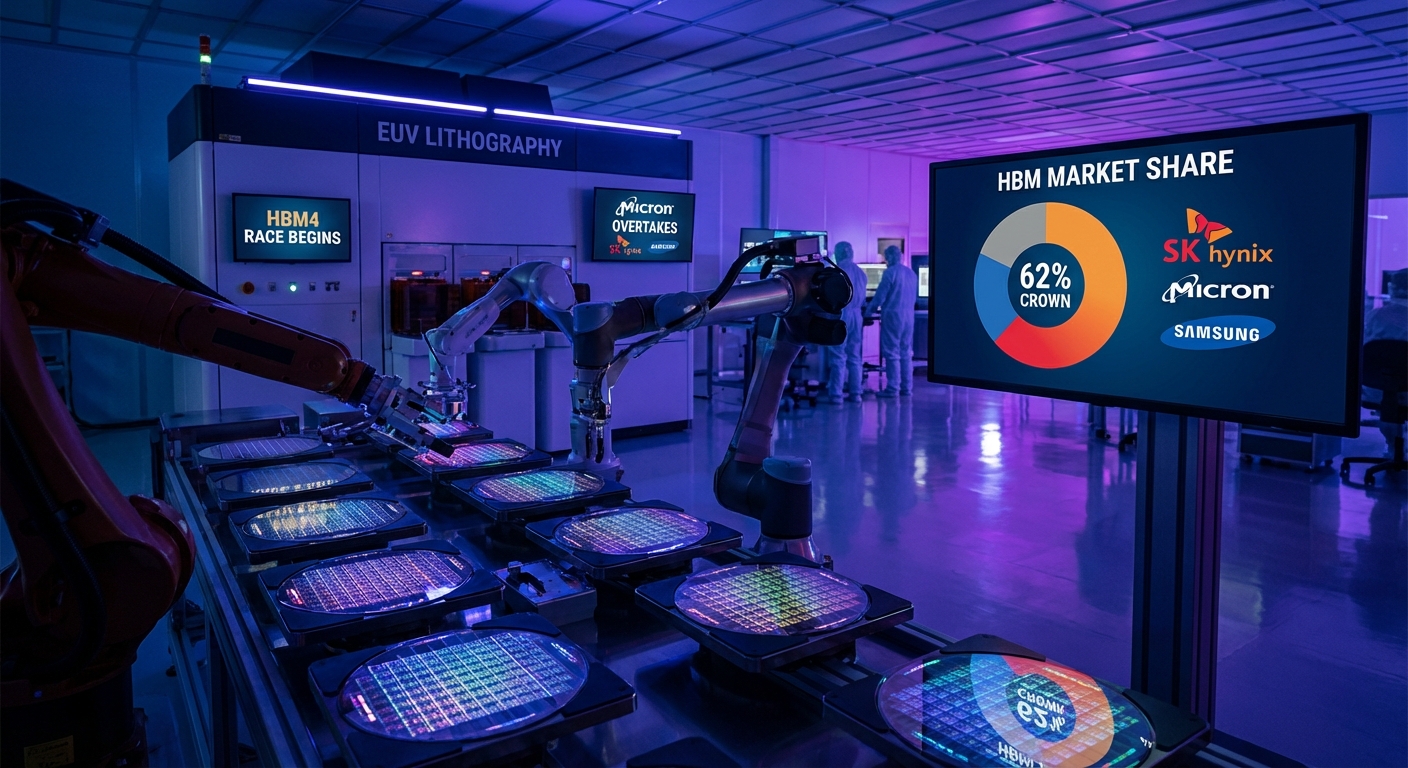
SK Hynix commands 62% of the global high-bandwidth memory (HBM) market, according to TrendForce data covering Q2 2025, with Micron Technology holding 21% and Samsung trailing at 17%. The figures confirm what analysts had anticipated: Micron has overtaken Samsung for the second-place position in a segment that didn't exist at scale just three years ago. SK Hynix's dominance is anchored by its long-standing supply relationship with NVIDIA, which absorbs the majority of available HBM capacity to fuel its Blackwell GPU line. KED Global reported on April 9 that SK Hynix has also officially overtaken Samsung as the world's largest DRAM maker by revenue — a landmark shift in an industry Samsung has led for decades.
With HBM3E supply largely allocated, competition has pivoted sharply to the next generation. SK Hynix has completed development of HBM4, claiming a 40% improvement in power efficiency and data rates of 10 Gbps per pin, and says mass production will follow once qualification is complete. Samsung began shipping initial HBM4 volumes after the Lunar New Year, with analysts projecting it will capture a mid-20% share of the 2026 HBM4 market — an improvement over its HBM3E position. Micron has shipped HBM4 samples rated at up to 11 Gbps and is working with foundry partners on future HBM4E products, projecting it will sell out its full HBM production capacity for the year.
The stakes are enormous. TrendForce projects that HBM4 will account for the majority of HBM revenue by late 2026, displacing HBM3E as NVIDIA's next-generation GPU platforms — including Rubin Ultra — require higher bandwidth. Samsung's memory division has been under particular pressure: its slower HBM3E qualification by NVIDIA and lower market share have weighed on profits, even as the broader memory market surges. Both Samsung and SK Hynix are constructing new HBM-dedicated fabs — Samsung's P5 facility in Pyeongtaek and SK Hynix's M15X in Cheongju — targeting readiness for HBM5 ramp in 2027 and beyond. For the AI buildout to continue at its current pace, all three memory makers need to succeed.
Sources
TrendForce, DigiTimes, KED Global