Iran Conflict Reignites "Taiwan Risk" Fears — TSMC Stock Drops 8% as Investors Reassess Concentration Risk
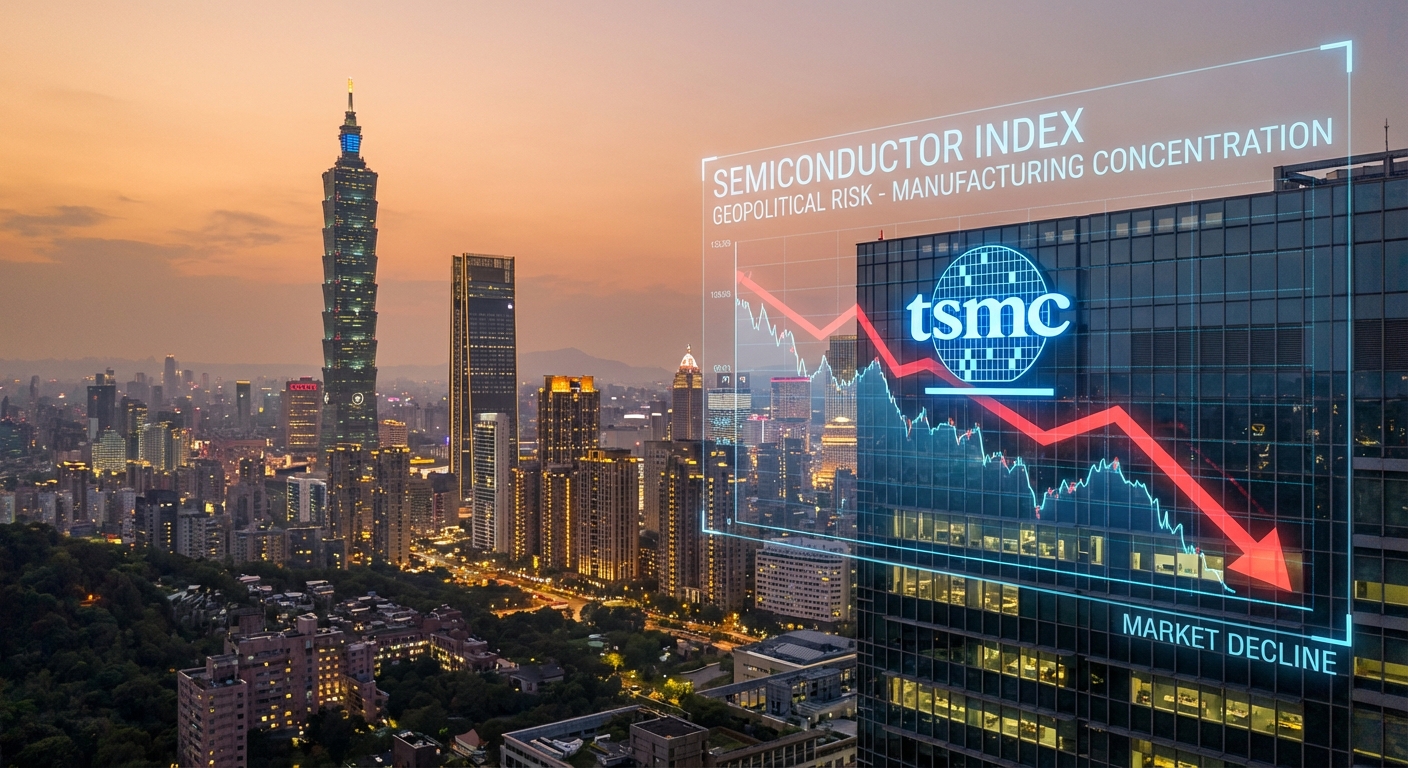
The Iran conflict has reignited investor anxiety over the semiconductor industry's overwhelming dependence on Taiwan, with TSMC shares falling 8% in a single week as fund managers reassess geopolitical concentration risk. The logic is straightforward: if a regional conflict in the Persian Gulf can disrupt global supply chains this severely, what would happen if tensions escalated in the Taiwan Strait? TSMC manufactures over 90% of the world's most advanced chips below 7nm, and any disruption to its operations would be catastrophic for the global economy. Morgan Stanley estimates that a six-month interruption to TSMC's output would cause $1.5 trillion in economic damage worldwide.
The fear premium has accelerated capital flows into "de-risking" plays: Intel and Samsung foundry stocks have rallied 12% and 9% respectively, while the U.S., Japan, and EU have all announced expedited timelines for domestic fab construction. TSMC's own geographic diversification — with fabs under construction in Arizona, Japan, and Germany — has taken on renewed urgency, though none of these facilities will reach leading-edge production before 2028. Hedge fund managers are increasingly building "Taiwan tail risk" positions, purchasing out-of-the-money put options on TSMC ADRs and semiconductor ETFs as insurance against a worst-case scenario. BlackRock's semiconductor portfolio strategy team has reportedly shifted $8.5 billion in allocation toward geographically diversified chipmakers, favoring companies with multi-region manufacturing footprints.
The broader geopolitical calculus is sobering. China conducted naval exercises in the Taiwan Strait within days of the Iran conflict's escalation, a move analysts interpreted as a signal that Beijing is closely monitoring how the West responds to simultaneous geopolitical pressures. Taiwan's Ministry of Economic Affairs has responded by accelerating a "silicon shield" contingency plan that would ensure critical TSMC intellectual property and key personnel could be relocated in an emergency scenario. Meanwhile, the White House has quietly assembled a task force to model the economic impact of various Taiwan contingency scenarios, with preliminary findings suggesting that even a 90-day disruption to TSMC's leading-edge output would trigger a global recession comparable to 2008. The Iran conflict has transformed what was previously an abstract geopolitical risk into a viscerally real concern for semiconductor investors worldwide.
Sources
Morgan Stanley, Bloomberg, Wall Street Journal, TSMC