Jensen Huang: AI Chip Manufacturing Bottlenecks Are a '2–3 Year Problem' — Energy Is the Real Long-Term Risk
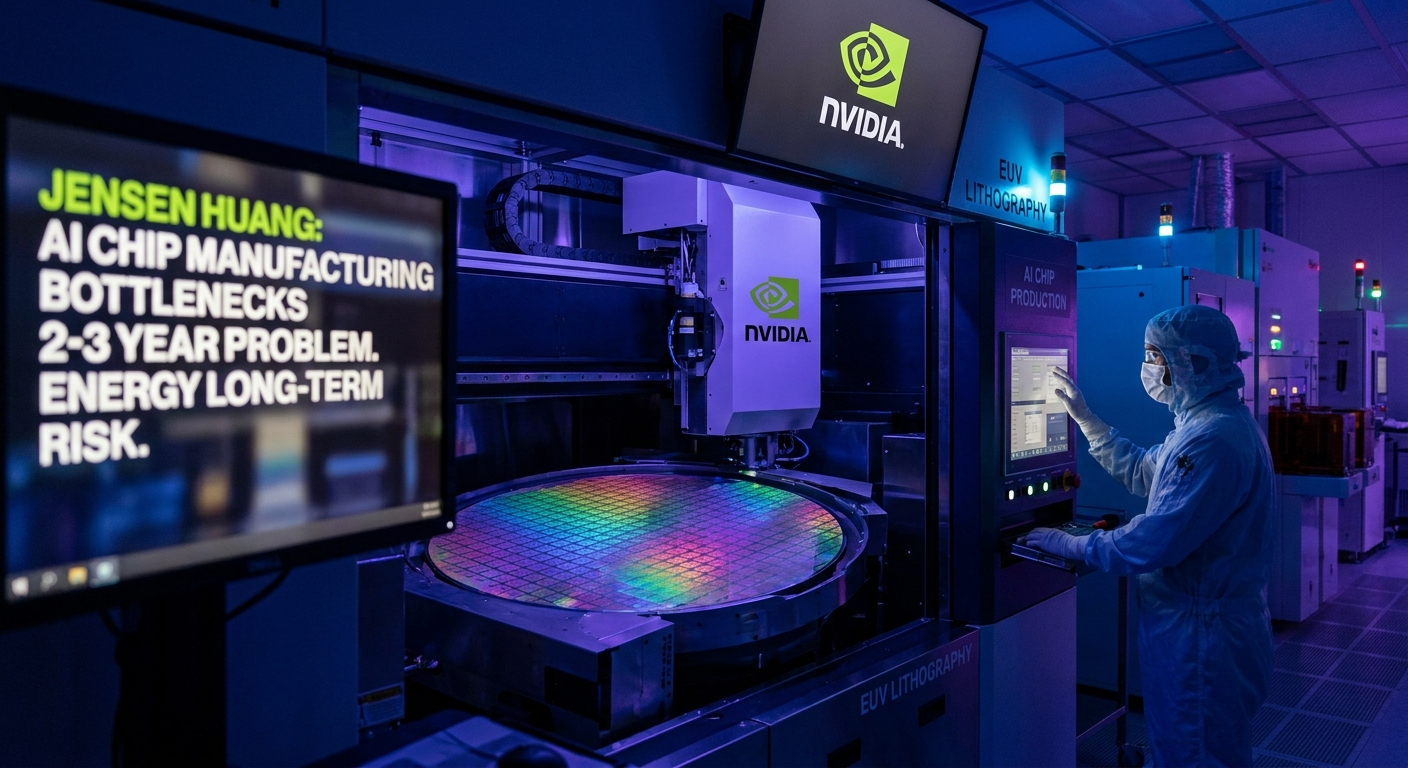
NVIDIA CEO Jensen Huang, speaking on the Dwarkesh Patel podcast published April 15, 2026, offered a remarkably optimistic view of the chip supply crunch affecting the AI industry. Huang stated that every bottleneck in logic fabrication, CoWoS advanced packaging, or memory — including the current HBM supply constraints affecting AI accelerator shipments — gets resolved within two to three years once the demand signal is clear enough to justify capital investment. 'None of the bottlenecks last longer than a couple of years, two, three years, none of them,' Huang said, specifically citing advanced packaging and EUV lithography capacity as areas where the industry has historically proven itself capable of scaling rapidly. 24/7 Wall St. covered the investor implications of the statement on April 21, 2026.
The NVIDIA CEO also addressed the ongoing CoWoS packaging constraint directly. TSMC's CoWoS technology — used to create the multi-chip packages that power NVIDIA's Blackwell and forthcoming Rubin AI accelerators — has been one of the most cited supply bottlenecks of 2025–2026. Huang's comments align with TSMC's own guidance: the Taiwanese foundry is simultaneously ramping two new CoWoS facilities in Taiwan and building two additional packaging facilities in Arizona, part of a broader $165 billion U.S. investment commitment. NVIDIA currently holds the majority of TSMC's leading CoWoS capacity, and TSMC has reportedly outsourced some packaging steps to third parties to meet demand. NVIDIA's order backlog through 2027 has been reported at approximately $1 trillion by industry trackers.
However, Huang identified one constraint he does not believe the industry can engineer its way out of on a two-to-three year timeline: energy policy. He warned that power availability — involving regulatory timelines, grid permitting, and national policy decisions — represents a legitimate long-term bottleneck that no single company controls. 'You cannot create a whole new manufacturing industry without energy, but these things take a long time,' Huang said, pointing to the complex intersection of AI infrastructure build-out and national energy policy. With AI data centers projected to consume a growing share of U.S. and global electricity generation, energy constraints are increasingly discussed alongside chip supply as a ceiling on AI scaling in the late 2020s.
Sources
Dwarkesh Podcast, DigiTimes