Samsung Cracks SOCAMM2 Warpage Problem With LTS Breakthrough — Gains Edge in Next-Gen AI Memory Race
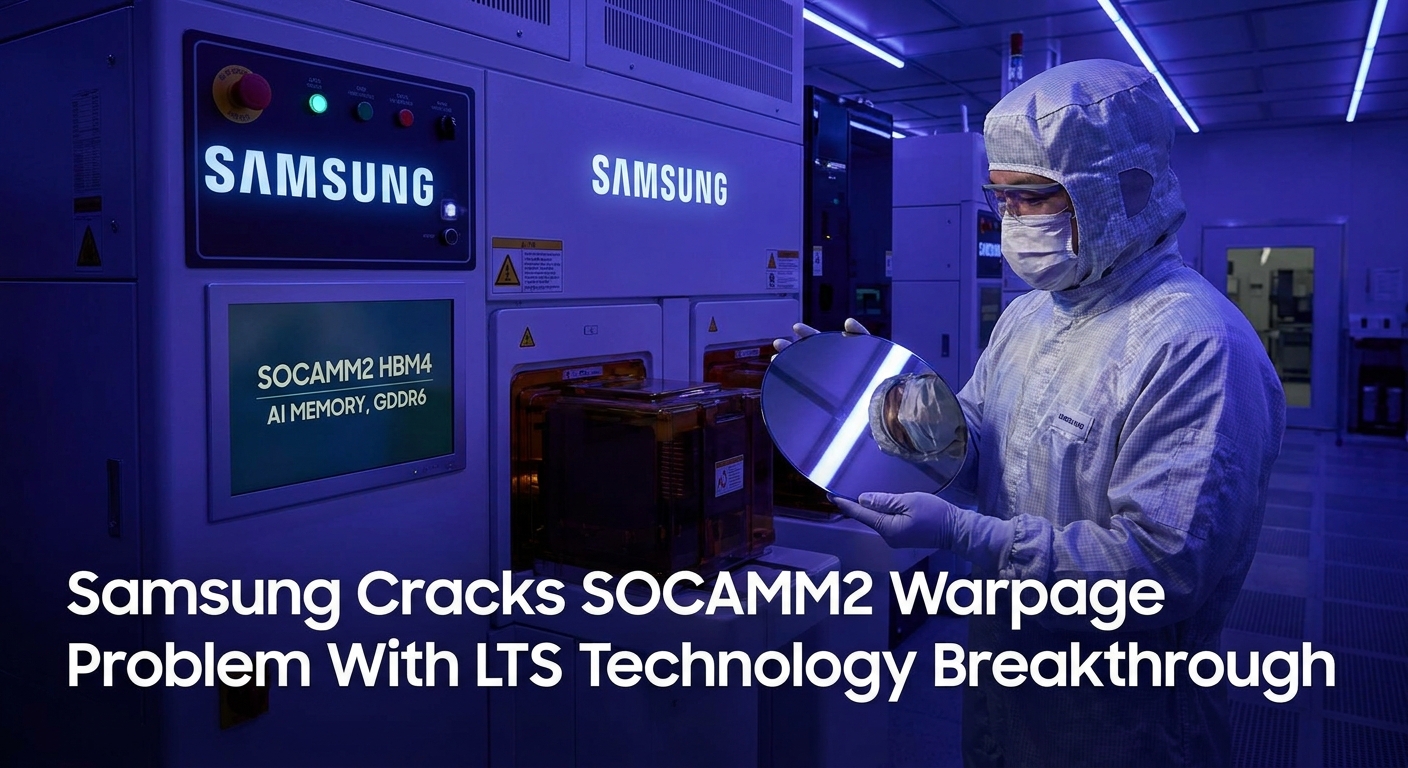
Samsung has reportedly solved a persistent engineering problem in the development of its SOCAMM2 next-generation AI server memory module, applying its internally developed low-temperature solder (LTS) technology to address a warpage defect that had been delaying mass production readiness. SOCAMM2, the successor to today's CAMM2 form factor, is designed for high-density AI training and inference workloads in next-generation servers — applications where memory bandwidth and thermal efficiency are as critical as raw compute. Samsung's resolution of the warpage issue is significant because both SK Hynix and Micron are still grappling with the same challenge, potentially giving Samsung a head start in mass production timelines ahead of server OEM qualification cycles for 2027 AI infrastructure builds.
The LTS approach reduces the heat required during the packaging bonding process, which minimizes the thermal expansion differential that causes warpage between the substrate and memory die layers. TrendForce noted that if Samsung can fully validate LTS at scale, it would position the company ahead of competitors for qualification slots at major cloud and server OEM customers. The breakthrough is part of a broader Samsung push to reassert memory technology leadership after an extended period of ceding the HBM (High Bandwidth Memory) market to SK Hynix, which has controlled approximately 50%+ of the HBM supply chain for NVIDIA's AI accelerators. Samsung plans to spend $73 billion on chip expansion and research in 2026 as part of this strategic offensive.
In parallel, DigiTimes reported on April 22, 2026 that Samsung is ramping GDDR6 production specifically for Tesla starting this month, as the automaker scales up its Dojo supercomputer and Optimus humanoid robot training infrastructure. Samsung is simultaneously scaling back its planned 1d DRAM (its latest-generation DRAM process node) mass production ramp — a sign that the company is rationalizing investment toward custom AI partnerships rather than broad consumer DRAM volumes. Together, the SOCAMM2 breakthrough and targeted production shifts suggest Samsung is executing a deliberate pivot toward high-value AI memory verticals in 2026 as it works to recover ground lost to SK Hynix and Micron in the prior cycle.
Sources
TrendForce, DigiTimes