U.S. MATCH Act Targets China's DUV Chip Tools — SMIC and Hua Hong Face Expanded Equipment Curbs
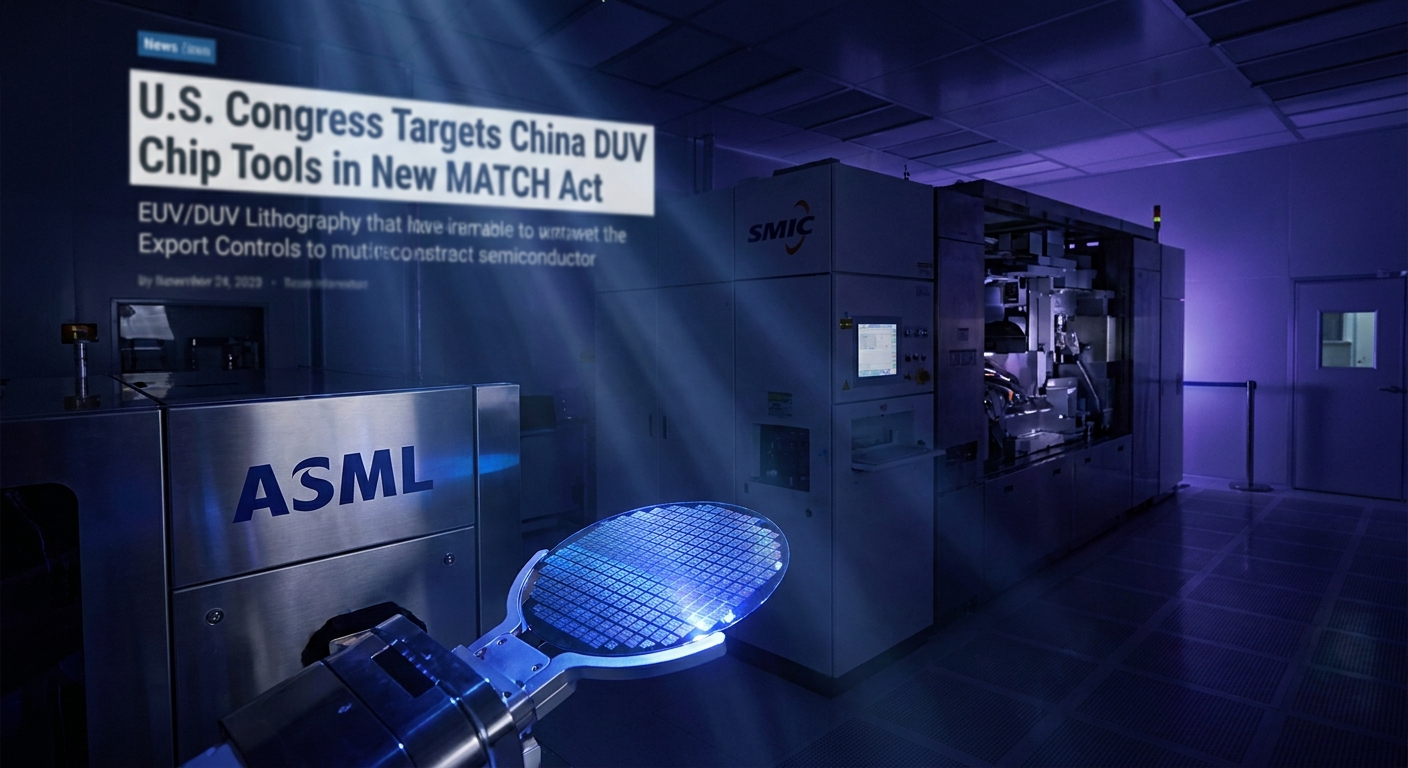
A bipartisan group of U.S. lawmakers introduced the Multilateral Alignment of Technology Controls on Hardware (MATCH) Act on April 2, 2026, proposing sweeping new restrictions on exports of semiconductor manufacturing equipment to China. The legislation would extend existing controls to include ASML's deep ultraviolet (DUV) immersion lithography systems and Tokyo Electron's cryogenic etching tools — equipment that China's leading chipmakers, including SMIC and Hua Hong, still rely on to produce less-advanced chips. Under the proposed rules, even maintenance and technical support for existing DUV installations would require U.S. government approval, making the impact more severe than a ban on new sales alone. ASML shares fell ~2.6% on the news before partially recovering.
The bill is designed to close a significant loophole in the current U.S. export control framework, which bars shipments of ASML's cutting-edge EUV (extreme ultraviolet) machines but has allowed DUV tools to flow to Chinese customers. SMIC and its peers have used DUV-based process stacking techniques — sometimes called multiple patterning — to push mature-node fabs closer to leading-edge performance without ever receiving an EUV system. The MATCH Act would also mandate allied-nation coordination, requiring the Netherlands, Japan, and other partner countries to align their national export controls with U.S. restrictions — a key provision given that ASML is Dutch and Tokyo Electron is Japanese. Separately, fresh data showed China's 2025 chip tool imports from Singapore and Malaysia hit record highs, while direct U.S. exports of chipmaking equipment to China fell to their lowest level since 2017.
TrendForce analysts interpreted the divergence in import origins as evidence that Chinese buyers are routing equipment purchases through third-country intermediaries to circumvent existing restrictions — a tactic the MATCH Act's allied-coordination clause is specifically designed to counter. If passed, the law would represent the most expansive U.S. chip equipment export restriction since the original EUV ban. For ASML, China exposure — already forecast to fall from 33% of 2025 sales to approximately 20% in 2026 — could compress further under the expanded controls, representing a multi-billion-euro headwind. The bill's progress will be closely watched by the broader semiconductor equipment sector, which has increasingly relied on Chinese demand to offset slower growth in other markets.
Sources
Bloomberg, TrendForce, CNBC