NVIDIA Vera Rubin Space-1 Module Targets Orbital AI Data Centers
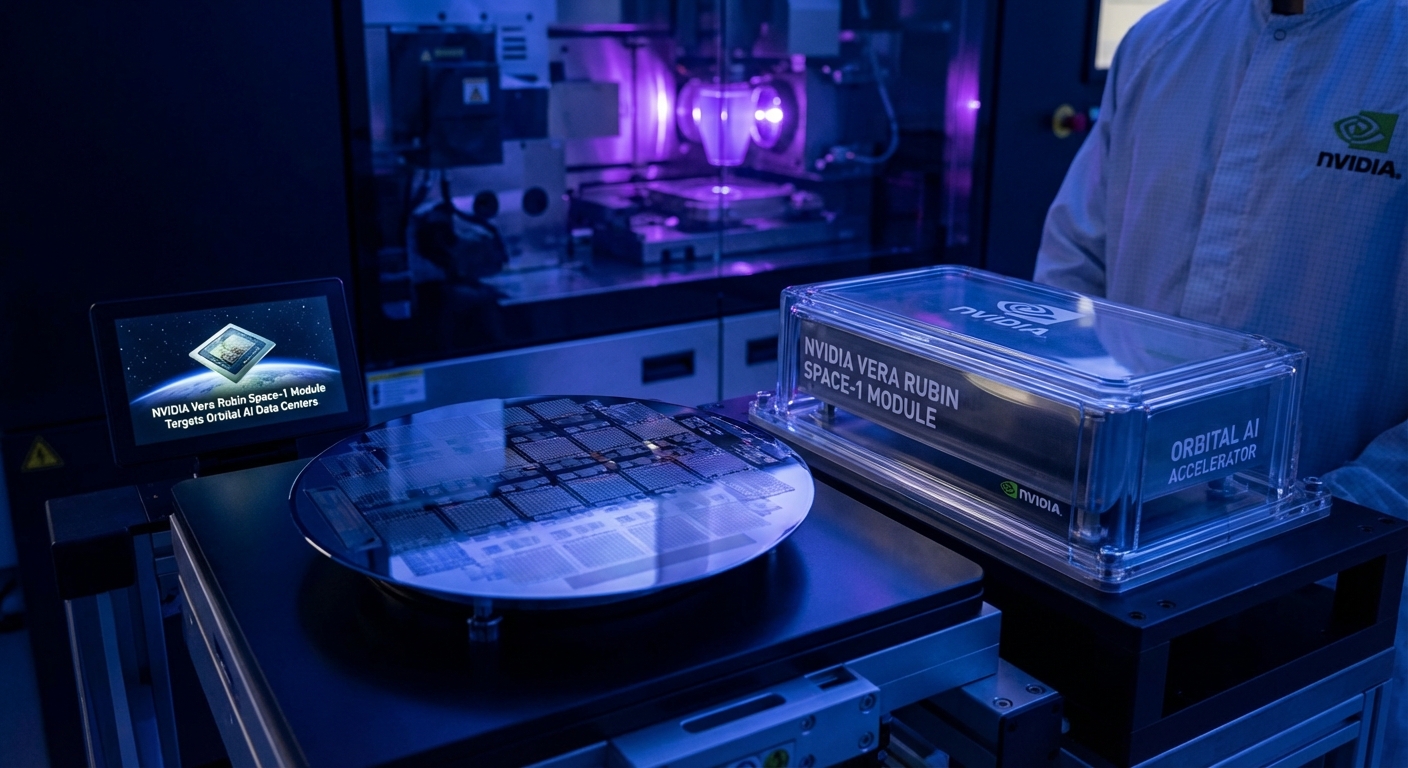
At GTC 2026, NVIDIA CEO Jensen Huang unveiled the Vera Rubin Space-1 Module, a radiation-hardened GPU compute platform engineered for orbital data centers. NVIDIA claims it delivers up to 25x the AI compute of the H100 in a space-qualified form factor, targeting low-Earth orbit (LEO) deployments from 2028 onward. The announcement reflects a broader industry shift as hyperscalers and defense contractors explore moving AI inference workloads off the ground to reduce terrestrial latency for satellite communications, reconnaissance, and autonomous systems.
The Space-1 module leverages the same Rubin GPU die used in NVIDIA's NVL72 rack systems, redesigned for the extreme thermal cycling and radiation environment of orbit. Unlike ground-based deployments — which can dissipate heat through liquid cooling — the Space-1 module uses a passive thermal management architecture compatible with satellite bus platforms. NVIDIA has not disclosed the number of GPU dies per module, but the 25x H100 performance claim suggests a configuration with multiple Rubin chiplets operating in a power-constrained envelope of approximately 5–10 kilowatts, aligned with the power budgets of large LEO platforms.
Early ecosystem partners include Axiom Space and Starlab, which are each building commercial space stations targeting operational status in the late 2020s. Both companies have flagged AI inference and real-time Earth observation processing as core workloads for their platforms. NVIDIA's timing also aligns with U.S. Space Force and DoD priorities around autonomous space domain awareness, a market that research firm NSR estimates will generate more than $8 billion in on-orbit compute spending by 2032. Analysts note that TSMC's radiation-hardening process extensions — developed through its partnership with DARPA — are a critical enabler for commercial GPU chips in the space environment.
Sources
CNBC, Tom's Hardware