TSMC April Revenue Hits NT$410.7 Billion as AI Demand Sustains 30% Growth Pace
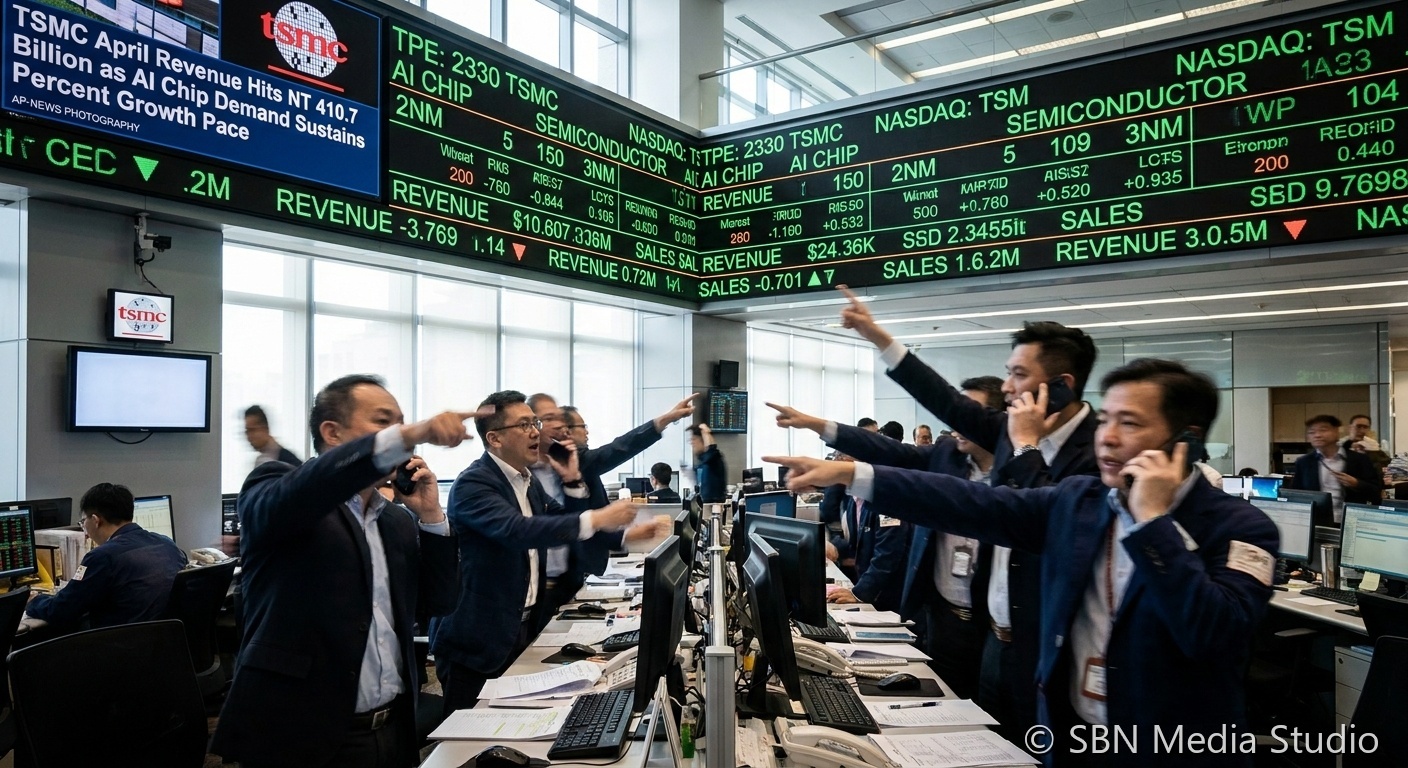
Taiwan Semiconductor Manufacturing Company reported April 2026 monthly revenue of NT$410.726 billion (about $13.0 billion), a 17.5% year-over-year increase that lands slightly below March’s seasonal peak but keeps the company tracking ahead of its raised full-year outlook, according to figures published via TSMC investor relations and circulated by DigiTimes and TradingKey. Cumulative January-through-April revenue reached roughly NT$1.55 trillion, an approximate 30% year-over-year gain that is consistent with management’s call last month to guide full-year 2026 growth to above 30% in U.S. dollar terms.
The April print is the latest data point in a year defined by AI capex. TSMC’s Q1 2026 earnings — reported on April 16 — showed a 58% profit jump on record revenue of NT$1.13 trillion, with high-performance computing accounting for 61% of revenue and advanced nodes contributing 75% of wafer revenue, per CNBC. NVIDIA’s reservations of CoWoS-L advanced packaging have effectively booked TSMC’s leading-edge utilization at near-100%, and the foundry has now outsourced parts of the CoWoS flow to ASE and Amkor to relieve bottlenecks. Apple’s reported preliminary deal with Intel — also this week — is the clearest sign yet that downstream OEMs are looking for a second source.
TSMC raised its 2026 capex guidance to the high end of the previously stated $52 billion–$56 billion range on the Q1 call to accelerate capacity additions in Taiwan and Arizona, where the company has confirmed it will host both CoWoS and 3D-IC capability before 2029. Management said leading-edge supply constraints will persist into 2027. For NVIDIA, AMD and Broadcom, that means continued allocation pressure on Vera Rubin, MI400 and custom accelerator volumes through the back half of the year — and for consumer-electronics buyers, continued risk that AI demand keeps eating the wafer slots that would otherwise carry phone and PC chips.
Sources
TSMC Investor Relations, DigiTimes, TradingKey, CNBC