AI Server Spending Jumps 45% in 2026 to $312 Billion — NVIDIA Sits on $275 Billion Backlog
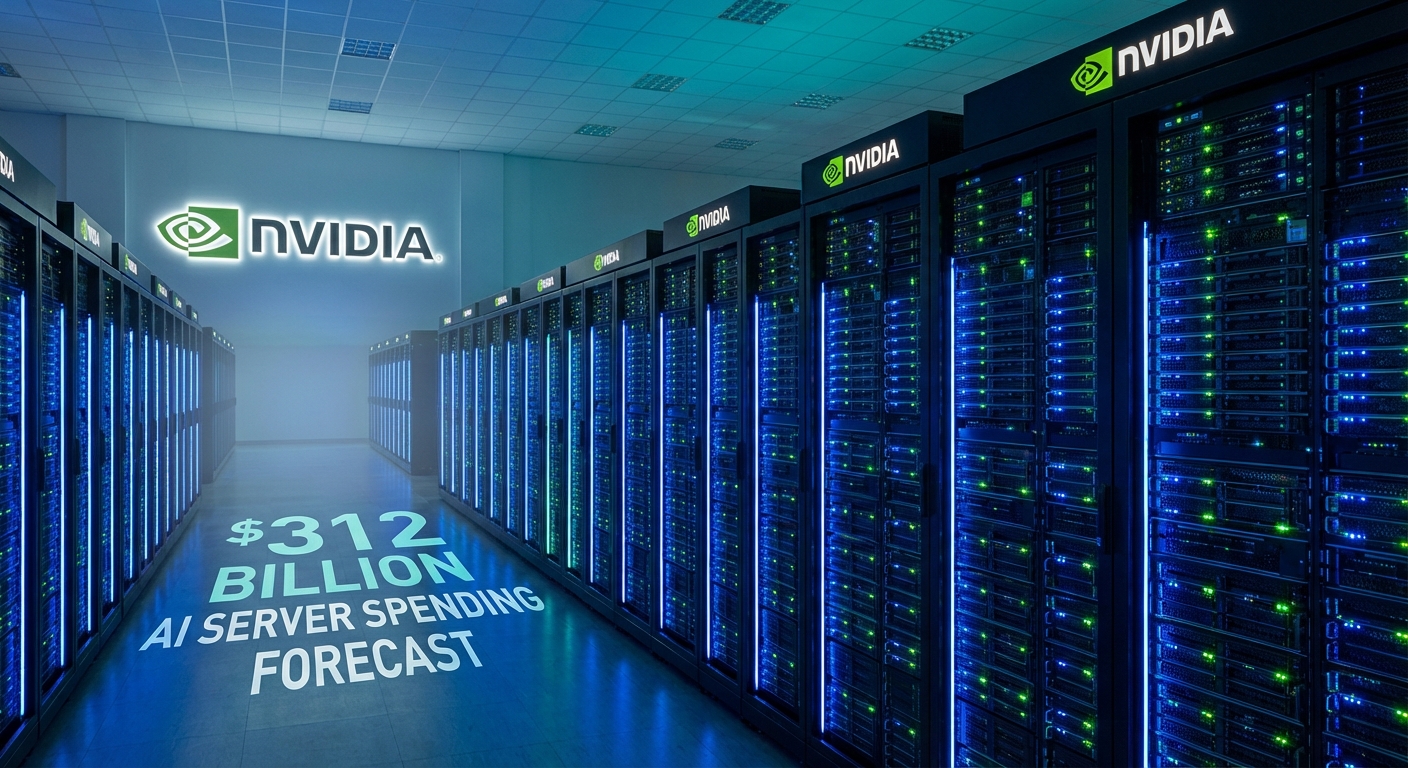
Global spending on AI servers is projected to surge 45% in 2026 to reach $312 billion, according to Bloomberg Intelligence, driven by hyperscaler capital expenditure programs from Microsoft, Google, Amazon, and Meta. The four largest hyperscalers have collectively committed to spending over $280 billion on AI infrastructure this year, with Microsoft leading at $80 billion, followed by Google at $75 billion, Amazon at $70 billion, and Meta at $55 billion. NVIDIA continues to dominate this market with a staggering $275 billion backlog of GPU orders, reflecting demand for its Blackwell and upcoming Rubin-series data center accelerators.
The spending surge has direct implications for the semiconductor supply chain: TSMC, which manufactures the vast majority of NVIDIA chips, is running its advanced nodes at maximum utilization, while HBM4 memory from SK Hynix and Samsung faces its own allocation challenges. Beyond the hyperscalers, a new category of "AI infrastructure companies" including CoreWeave, Lambda, and Crusoe Energy is driving incremental GPU demand, collectively ordering an estimated $40 billion in NVIDIA hardware for 2026-2027 delivery. Sovereign wealth funds from the UAE, Saudi Arabia, and Singapore are also building national AI compute capabilities, adding another layer of demand that barely existed two years ago.
AMD is also capturing an increasing share of the AI accelerator market with its Instinct MI400 series, which offers compelling performance-per-dollar for inference workloads and has secured design wins at Microsoft Azure, Oracle Cloud, and several European supercomputing centers. AMD's AI data center revenue is projected to reach $12 billion in 2026, up from $6.1 billion in 2024, though NVIDIA still commands over 80% of the total AI accelerator market. The scale of AI infrastructure investment has made semiconductor manufacturing the most strategically important industrial sector of the decade, with national security implications that extend far beyond traditional defense applications. Barclays Research estimates that AI-related semiconductor demand will account for 35% of total industry revenue by 2028, up from approximately 20% today, fundamentally reshaping the economics and geopolitics of the chip industry.
Sources
Bloomberg Intelligence, NVIDIA, Barclays Research