NVIDIA DLSS 5 Neural Rendering Unveiled at GTC 2026 — The "GPT Moment for Graphics"
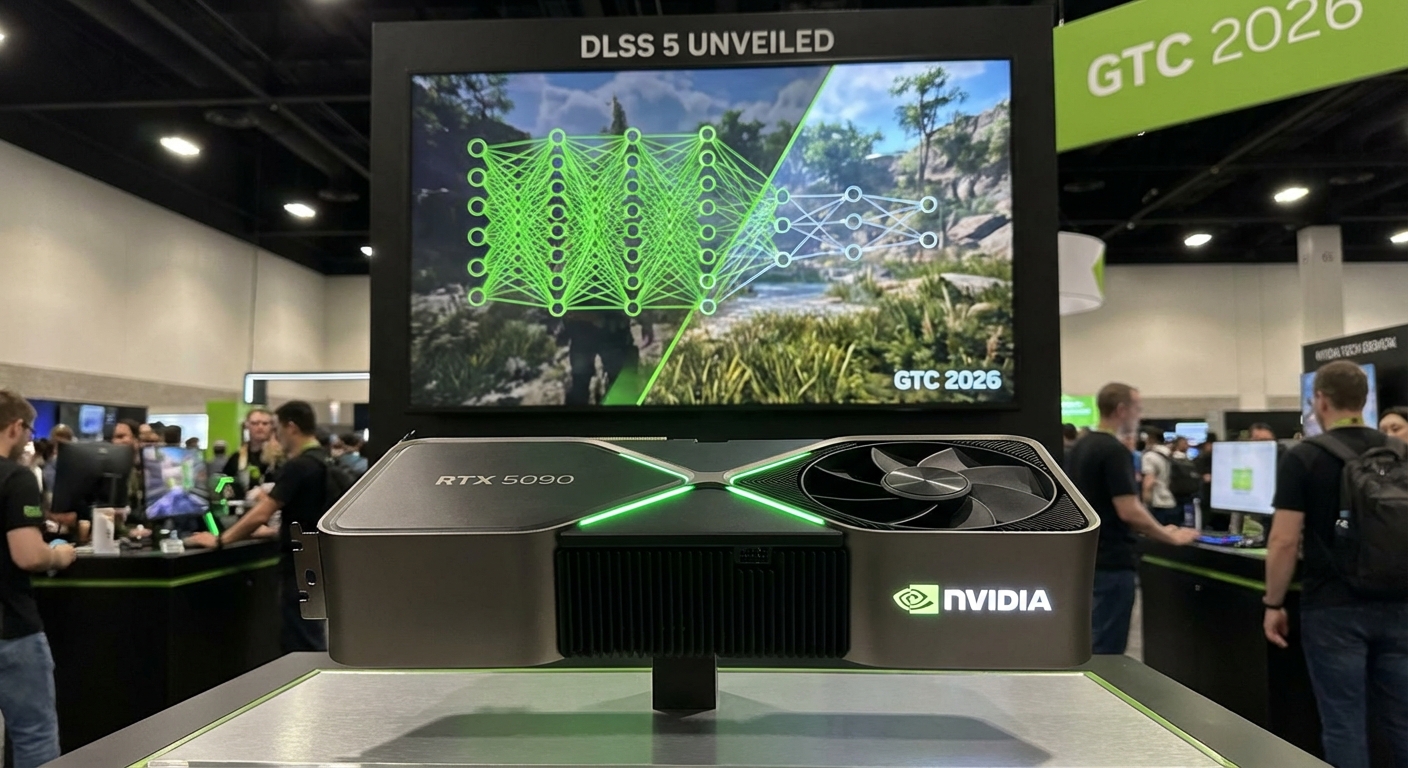
NVIDIA used GTC 2026 to reveal DLSS 5, a paradigm shift from traditional upscaling to full neural rendering. Rather than reconstructing pixels, DLSS 5 uses a generative AI model to synthesize photoreal lighting, materials, and shadows in real time at up to 4K resolution. CEO Jensen Huang called the technology a reinvention of computer graphics 25 years after the programmable shader. The system is exclusive to RTX 50-series GPUs, with the RTX 5090 serving as the flagship. Demos were shown running in titles from Bethesda, Capcom, Ubisoft, and Warner Bros., though NVIDIA acknowledged that performance optimization is still in progress.
The technical architecture behind DLSS 5 represents a fundamental departure from previous versions. While DLSS 1 through 4 focused on reconstructing missing pixel data from lower-resolution inputs, DLSS 5 employs a transformer-based neural network that generates entirely new visual information — synthesizing realistic light bounces, material properties, and shadow cascades that were never explicitly rendered by the game engine. NVIDIA claims the model was trained on over 50 petabytes of ray-traced reference data collected from hundreds of games and film-quality CGI sequences over the past three years.
DLSS 5 is expected to ship this fall, running on top of DLSS 4.5 upscaling and multi-frame generation for a combined quality and performance boost. Sixteen launch titles have been confirmed, spanning major publishers including Bethesda, Capcom, Ubisoft, and Warner Bros. The RTX 5090, priced at $1,999 MSRP, is the only current GPU with sufficient Tensor Core throughput and 32 GB of GDDR7 VRAM to run the full neural rendering pipeline. However, NVIDIA has indicated that a streamlined "DLSS 5 Lite" mode may come to the RTX 5080 and RTX 5070 Ti later in 2027, using a smaller model with reduced quality but still surpassing DLSS 4.5 in visual fidelity. Industry analysts at JPMorgan estimate DLSS 5 could drive $4.2 billion in incremental RTX 50-series GPU sales through 2027 as enthusiasts upgrade specifically for the neural rendering capability.
Sources
NVIDIA, Tom's Hardware, Digital Foundry