Semiconductor Equipment Market Reaches $29.1 Billion in 2026 — 10.1% CAGR Through 2030
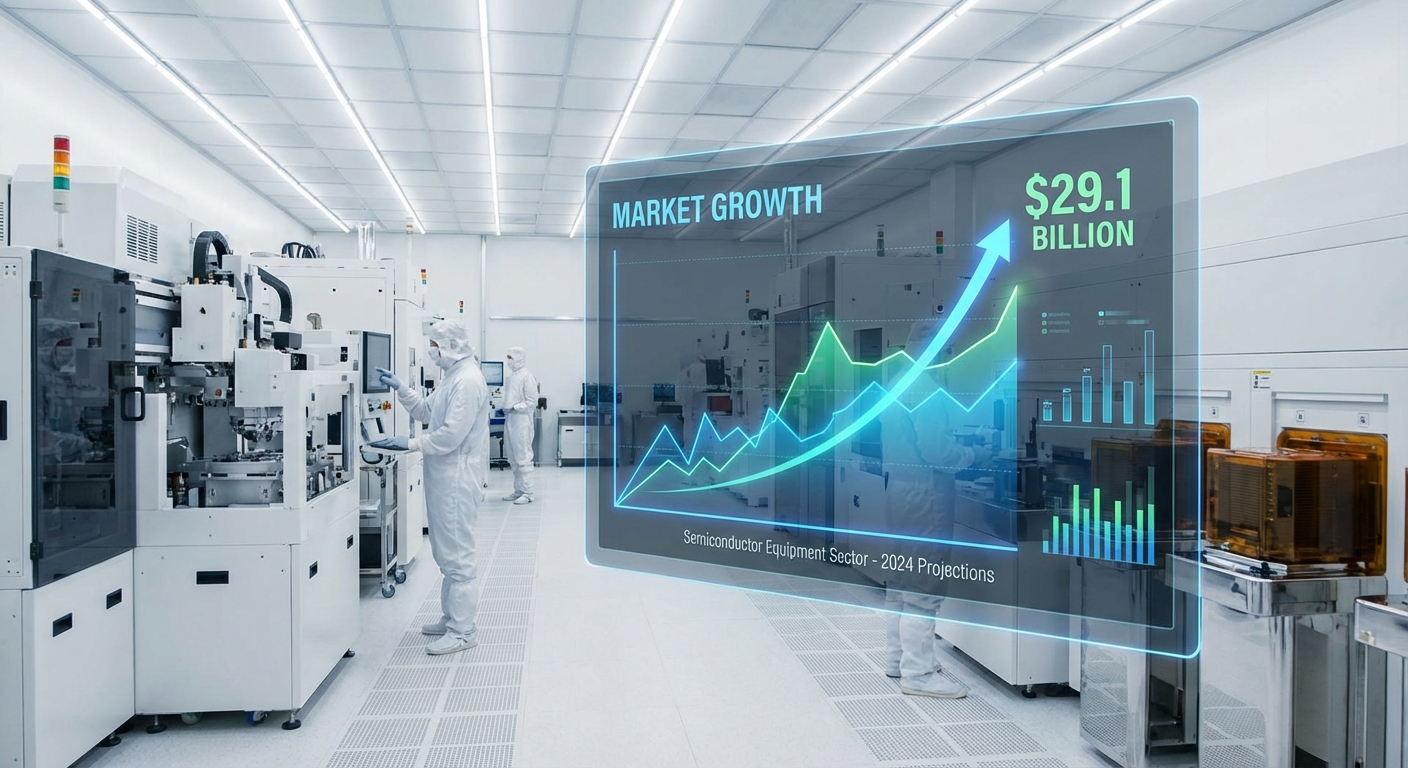
The global semiconductor equipment market has reached $29.1 billion in 2026, growing at a compound annual growth rate of 10.1% and projected to hit $42.76 billion by 2030, according to new industry analysis. The growth is being driven by massive capital expenditure from TSMC, Samsung, and Intel as they race to build out capacity for advanced process nodes and advanced packaging technologies. TSMC alone has committed to $38-40 billion in capex for 2026, the largest single-year investment by any semiconductor company in history, with approximately 70% allocated to leading-edge 2nm and 3nm capacity and the remainder split between advanced packaging expansion and specialty technology nodes.
EUV lithography equipment from ASML accounts for a disproportionate share of the spending, with each High-NA system priced above $380 million and standard EUV systems at $200 million each. Beyond lithography, the transition to gate-all-around nanosheet transistors has created surging demand for atomic layer deposition (ALD) and atomic layer etch (ALE) tools from Applied Materials and Lam Research, as GAA architectures require atomic-precision material deposition around complex 3D channel structures. KLA Corporation's inspection and metrology tools have also seen record demand, as the shrinking margin for manufacturing defects at 2nm makes quality control more critical than ever.
Semiconductor stocks have outperformed the broader technology sector year-to-date, with ASML, Applied Materials, and Lam Research all reaching or nearing all-time highs. The equipment sector has become a leading indicator for the broader semiconductor cycle, and the current order trajectory suggests sustained growth through at least 2028. SEMI's World Fab Forecast database now tracks over 90 new fab construction projects worldwide, the highest number in the organization's tracking history, driven by government subsidies from the U.S. CHIPS Act, European Chips Act, Japan's semiconductor strategy, and similar programs in South Korea, India, and Southeast Asia. The equipment supply chain itself is becoming a bottleneck, with lead times for critical tools stretching to 18-24 months and forcing chipmakers to place orders years in advance of planned fab openings.
Sources
SEMI, Fortune Business Insights, Statista